The Town in the Details: A Slow Wander Through Camberley's Overlooked Corners
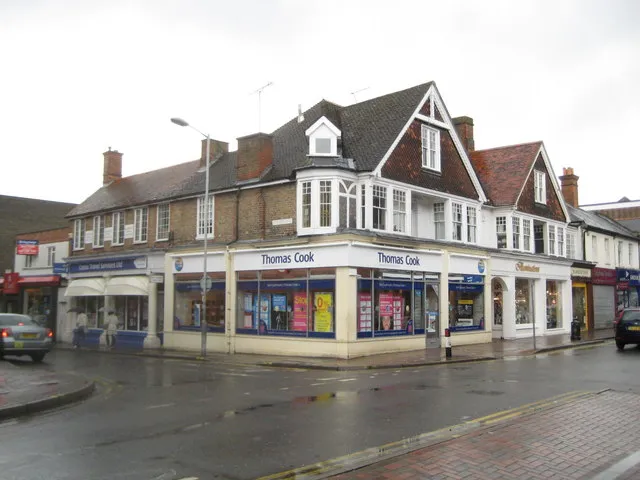
Photo: Nigel Cox, CC BY-SA 2.0, via Wikimedia Commons
Camberley is the sort of place you can navigate on autopilot. Coffee, bank, boots, bus home. Nothing wrong with that — it is how most of us get through a Saturday. But every now and then it pays to switch off the sat-nav in your head and take the long way round. This is a gentle, no-booking-required wander through the town centre, built around ten small details you have almost certainly walked past a hundred times. None of them will take more than a minute to spot. Together, they turn an ordinary errand into a proper little outing.
1. The faded lettering that only appears at an angle
Start on London Road and look at the upper brickwork rather than the shop windows. Every so often, when the light falls at the right angle, you can make out the ghost of old painted signage — pale lettering that once advertised a grocer, a cycle shop or a draper. These so-called ghost signs were common in Victorian and Edwardian high streets, when brick was the billboard and paint was cheaper than a modern shopfront sign. Many were simply overpainted when businesses changed hands, which is why they survive as shadows rather than statements. Go and see: stand slightly to one side of the pavement and look up. If the sun is low, you will get a free history lesson.
2. Carved dates above doorways
Look above the modern fascias and you will find dates cut into stone or brick — sometimes a single year, sometimes a pair marking a rebuild. They are easy to miss because we tend to look straight ahead at eye level. But those numbers are tiny anchors in the town's timeline, marking when a terrace was extended, a corner was squared off or a new frontage was added. You do not need to know the full story to enjoy the clue. Go and see: pick a stretch of older buildings near the High Street and walk it slowly, scanning the brickwork just above the first-floor windows.
3. Parapets, finials and the odd roofline quirk
Camberley's roofline is more interesting than it gets credit for. A parapet — the raised bit of wall that hides a roof — was often added for looks rather than practicality, giving a plain building a bit of civic swagger. Finials, the little decorative flourishes at the top of a gable, were the icing on the cake. Once you start noticing them, you cannot unsee the difference between a building that was designed to be looked at from the street and one that was built purely for function. Go and see: stand on the opposite pavement and trace the tops of the buildings rather than the bottoms. It is a completely different town up there.
4. The royal cipher on a post box
There is a quiet thrill in finding an old post box with a royal cipher — the raised lettering that tells you which monarch was on the throne when it was installed. Camberley has its share of these cast-iron survivors, and each one is a small piece of street furniture history. The cipher is usually near the top of the box, sometimes worn smooth by decades of weather. Go and see: next time you post a letter, take ten seconds to look at the lettering. It is the cheapest time-travel available on a Tuesday morning.
5. Bench plaques and the people they remember
Public benches are almost invisible until you need one. But look at the backrest and you will often find a small brass plaque — a dedication to someone who loved this spot, this walk or this town. These are not grand memorials; they are everyday ones, which makes them oddly moving. A bench plaque turns a piece of municipal furniture into a story. Go and see: choose a bench with a view, sit for a minute and read the plaque. Then enjoy the view on their behalf.
6. The old shopfront pilasters
Even where a shop has been modernised, the bones of the old frontage often remain. Look for pilasters — the shallow pillars at either side of a shop window — and the corbels or brackets above them. These were designed to frame a display and give a business a bit of presence. Some are painted over, some are half-hidden behind signage, but they are still there, holding up the shape of the street. Go and see: walk one side of the High Street and count how many shopfronts still have their original vertical lines. It is a nice game for a rainy afternoon.
7. Pavement ironwork and manufacturer names
Look down. Genuinely, look down. Old drain covers, coal-hole covers and inspection plates often carry the name of the foundry that made them, sometimes from a town miles away. They are the fingerprints of Victorian and Edwardian infrastructure, cast in iron and built to outlast us all. Some are worn, some have been replaced, but the survivors are worth a glance. Go and see: pick a quiet stretch of pavement and see how many different foundry names you can find. It is strangely addictive.
8. Window arches and the brickwork above them
Above many old windows you will find a shallow arch or a row of shaped bricks. These were not just decorative — they helped spread the weight of the wall above the opening. But the bricklayers often made them beautiful anyway, with contrasting colours or a little pattern. Once you notice them, the upper floors of the town centre start to look much more deliberate. Go and see: stand back from a terrace and follow the line of window tops. The rhythm of arches is one of the quiet pleasures of an old high street.
9. Boundary markers and old street names
Camberley has changed its shape more than once, and the evidence is still out there in small ways — a street name that no longer quite fits, a marker stone or a sign that hints at an older parish boundary. You do not need to be a local historian to enjoy the puzzle. These details remind you that the town was stitched together from different pieces over time. Go and see: take a side street off the main drag and read the name plates. Some of them are older than the buildings around them.
10. The watermark of everyday repair
Finally, look for the small signs of repair — a patch of brickwork that does not quite match, a stone sill replaced in a different colour, a doorway that has been raised or lowered. These are the town's scars and stitches, and they tell you that Camberley has been lived in, altered and looked after. A perfectly preserved street is a museum; a repaired one is a home. Go and see: choose one building and give it a proper look, top to bottom. You will find at least one story in the mismatch.
Make a wander of it
None of this needs a map or a ticket. A loop from the High Street down London Road and back through the side streets will take you past most of these details in under an hour, with time for a coffee in the middle. Take a friend who thinks they know the town, and watch them start spotting things too. The best local walks are not always about leaving Camberley — sometimes they are about finally arriving in it.